Saturday, March 19, 2011

Golden Jubilee celebration of Jalpaiguri Government Engineering College: Alumni Meet


Welcome to Alumni Association of Jalpaiguri Government Engineering College
On 12th March, 2011, around 250 ex-students of Jalpaiguri Government Engineering College (JGEC) had visited the college premises. The occasion was Annual Re-union program. 2011 is very special for JGEC, because the college is celebrating golden jubilee in this year. The re-union program was in the evening. The program was inaugurated by Principal Professor Jatyirmay Jhampati. Professor Jhampati is also ex-student of the college and member of official alumni.
 
Dr. J. Jhampati addressing at Alumni Meeting
In the morning, lots of ex-students were present in the college seminar hall to attend the official alumni meet. The program was anchored by Mr. Gautam Bhaduri (1983 batch). Mr. Bhaduri is the secretary of the alumni. Dr. Jhampati also was present in this morning meeting.
 
Alumni Meeting at Seminar Hall
Dr. Jhampati had explained the future plan for college, and also had stressed on the college-alumnus relationship. Mr. Tapas Saha, who is one of the head of current Durgapur-Asansol Alumni, had also delivered his lecture. He had told about the importance of centralized alumni having head quarter at college premises. He also explained the possible relation and interaction between central official alumni and present local alumni at various places. All the members of the meeting had agreed that the official alumni will be the core; whereas present various local alumni will work as branch or chapter under the umbrella of official central alumni. The various local alumni will organise local get together and social activities in the locality, whereas the central alumni will act for direct development of the college and its members.
 
Hostel No. 1, Jalpaiguri Govt. Engg. College

Hostel No. 2, Jalpaiguri Govt. Engg. College

Amaresh, Rajib and Nirjhar (1996-2000 Batch), at background Hostel No. 3
It was also discussed that, if any local alumni do not want to accept the official alumni, then what will be role of official alumni. Mr. Gautam Bhaduri had given me opportunity to deliver lecture in the meeting. Regarding conflict between official alumni and any local chapter, I had pointed out that, any local alumni have limited membership. But by virtue of its official presence, the newly formed central official alumni will be able to generate a huge membership, and in long run all the future generation will become member of official alumni. So, there will be a time, when the local alumni which do not support official alumni will cease or become microscopic minor. So at present it is better to avoid any conflict with any local alumni which do not accept official alumni. Because, ignoring conflict is also a method of avoidance of conflict. All the members were agreed with this view.

Some near future activities of alumni will be as follows:

1. Alumni will generate a web page, where ex-students can directly enroll their names as a member. 1992 batch ex-students had started this discussion, which all the members also had supported.


2. Alumni will organize re-union program of ex-students in future.

3. Alumni will guide final year students for job related issues.

4. Alumni will co-ordinate with all existing chapters of alumni, which are situated at different parts of the globe.

5. All ex-students can directly contact alumni for any college related issues.

Arnab Guha of 2000 Batch had pointed out that, when a student will complete his study and go to any city for further assignment, then alumni can provide him contact of ex-students who are already present in that city and who may guide him about that city. Also he had suggested alumni to think the possibility of economic help to just pass out students for a given short period.

Ex-students from different batches had delivered lectures and had opined on various issues. All were fascinated with the attendance of this reunion program. 1985 batch ex-students had a huge presence in this whole show.

Also, many ex-students had explained the role of alumni to spread the name of college to the out side world. Many newly formed colleges, despite of their lower education quality, are able to advertise themselves. But it is true that, 50 years old JGEC, which is the only government technical graduation school of vast area of North Bengal, is not able to advertise itself in accordance to its status.
 
Present office of Alumni Association Head Quarter
At present the alumni has an office at first floor of college building. Mr. Gautam Bhaduri has appointed an office assistant (popularly known as Nimuda by college students). At present any ex-student has to pay one time Rs. 100 to get a life time membership.

At evening, all the ex-students were present on football ground; just beside the ladies hostel. They had gathered in the ground to attend a football match between alumni members and present students. Many ex-students had refreshed their old skills on the field. It was a great fun. The ex-students, who were tired with their present tough schedule, had enjoyed the fun with the memory of their golden past.
 

On the field, refreshing old skills

Sombuddha (1996-2000) in action, with other; All still fit perfect with the ambience
After the great football match, the reunion committee under the leadership of present final year student, Hasan Mustafa, had invited the ex-students at Oval ground for a great facilitation program. The program was started with a show by the students of night school which is run by present JGEC students. Present JGEC students run a night school where under privileged boys and girls get free education. From first batch (1966 pass out) to last batch (2000 pass out) students ware present in this facilitation program. All were amazed to see the first batch students. Many ex-students also had come from abroad to join this program. The final year students had given me the opportunity to co-ordinate that great show, for which I am extremely thankful to him. It just reminded me the college days, when I used to anchor many shows, including our great skit (short drama) shows.  

We belongs to this Fraternity; The senior in extreme left is from the First Batch of JGEC! 
Mr. Tapas Saha greeted the audience with a great musical show
1992 Batch with emotion & euphoria

1991-1995 Batch entertained the audience with great musical performance, lead by Debasishda; Photo by Soumya

Here we are, once again (1996-2000 batch)
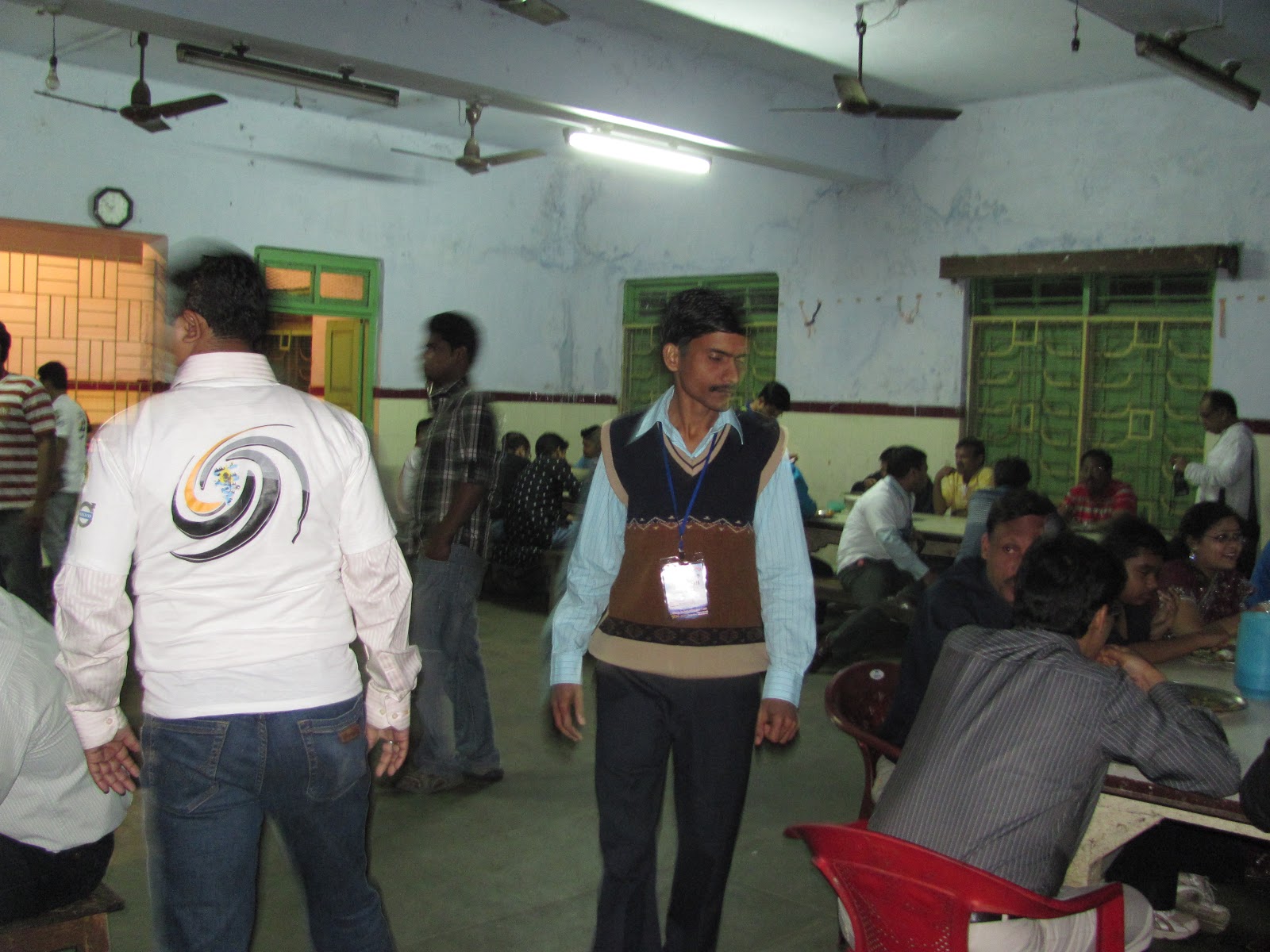
After the facilitation program, there was dinner party at 4th year hostel canteen. It reminded me the taste of ID (ideal dish), after a long time. Old college staff, popularly known as Punditji, had come to the canteen to meet old geniuses. At present, Punditji's son, Nabin is taking care canteen of hostel no. 3.
 
At Dinning Hall, Hostel No. 3

Once again, in old mood

Adda at Common Room
Adda at common room, masti in front of dining room, thek at hostel rooms…suddenly all became reality once again.
 
No more syllabus pressure! Thank God!
All the ex-students were extremely nostalgic. Everybody had left these good old lanes, but these lanes will never die in their memory…because JGEC is present in their sole, forever……. forever.

Ladies Hostel in front and Oval at Background

Amaresh (1996-2000) with Professors

College Building, from back side
 
College building; & Bhaida's canteen
Amaresh, Nirjhar & Rajib with Ramda, 4th year hostel canteen
View from Hostel No 3: Hostel No. 2 and Medical Centre

College from National High Way
  

College Building, in celebration mood

Tea Garden, with its silence (from Hostel No. 3, JGEC)

Wednesday, February 23, 2011

1st Official Alumni of Jalpaiguri Government Engineering College at Campus

http://jgecalum.org/
It was a cold evening of December, 1999. Sun disappeared behind the Krishnachura trees. I was watching the tea garden from the fourth year hostel of Jalpaiguri Government Engineering College (JGEC). Gradually, I realized the definition of silence!

Most of the things of this 50 years old engineering college of East India interpret this silence of tea garden. But this silence of tea garden never stops the flow of small River Rukruka. Life moves within the silence!

The first ever official alumni of JGEC at own campus is not an exception! It started function silently, echoing the “voice of JGEC”, i.e. “silence”! It has an office within the college premises. Do not ask about date of inauguration; do not ask about the originator! Neither “silence” can be described with dates, nor “silence” be originated! Just feel the flowing Rukruka within the silence! Official alumni of JGEC is just like the “Rukruka” within the silence of tea garden.

At present the official procedure of alumni association(The Jalpaiguri Government Engineering College Alumni Association) is in forming stage. Mr. Gautam Bhaduri of ’83 pass-out batch is coordinating different agencies for the formation of alumni. Now it is time for all the different alumni unions to come together and make a bigger platform, with a base office at college campus, and moreover which is officially recognized by college administration as well.

There can be many debates over this issue. But it is time for all the ex-students and present students of JGEC to share a common platform with close coordination. All the students of this picturesque college love JGEC and try to keep close interaction within JGEC ex-students with best of their abilities. But in this process the ex-students can not ignore present generation of students. The whole purpose of alumni is to elevate the status of college. The purpose of alumni is not to perform cultural functions and get together only. Status of the college can be elevated if present and past students share a single stage. So it is an opportunity, it is a rare river “Rukruka” with the silence of tea garden. Just come and sit at the bank of Rukruka and feel it.
All the photograpgs are taken by students of JGEC
[Official website for The Jalpaiguri Government Engineering College, www.jgecalum.org inaugurated on 7th August 2012]
Note: The Jalpaiguri Government Engineering College Alumni Association got registration on 22nd day of April 2010 from Registrar of Societies West Bengal Act XXVI of 1961 vide No:-S/L/70053 of 2010-11. The Alumni Association functions from College Administrative Building.

Tuesday, February 15, 2011

Fall of Mubarak: Law of History

Timesnow reports:
Egyptian President Mubarak resigns

11 Feb 2011, 2155 hrs IST, AGENCIES

Hosni Mubarak, who ruled Egypt with an iron hand for over three decades, stepped down as President today (Feb 11) and handed over power to the army capitulating under mass protests sweeping the country's streets for the last 18 days. President Hosni Mubarak resigned and handed over power to the military, announced the recently appointed vice president Omar Sulaiman on state television.

Tahrir Square, the epicentre of the anti-government protests, erupted in joy with tens of thousands of people shouting 'Egypt is Free". The end of a despotic regime in most populous Arab nation came one week after the protesters set a deadline of 'Departure Friday' for 82-year- old Mubarak to step down as President.

Link: http://www.timesnow.tv/Egyptian-President-Mubarak-resigns/articleshow/4365055.cms

*****************************************************

Fall of Mubarak at Egypt proves the law of history. History in all senses is art. It has no relation with so called science! So how can history have laws? But history is not only a mere art, rather in bigger senses it is social science, and it also follows some certain rules and laws. May be these laws are not as stringent as science, may be these laws are not experimentally proven in laboratory. But if you consider the whole world as a laboratory, then ofcourse historical laws show its repeatation. Fall of Mubarak is just an example. From its early civilization, people have always protested against autocratic regime. Upto a certain level human being is flexible enough to acknowledge a leader and follow a leader’s order. But when the leader become autocratic, and when the leader’s act deprive people in general, then anger starts, and gradually it creates cloud against power and at one time it erupts. Relevant examples act as catalyst for these eruptions. In case of Egypt, fall of Tunisian autocratic leader, Ben Ali, acts as catalyst for Egypt. After Egypt, other gulf countries, like Yemen and Algeria, are also protesting against internal autocratic governance.

Also, history has experienced that, most of the revolt has a financial character. Finance, in general, plays an important role to mobilize people against autocrats. In recent times, it has been heard that, Egypt has very fragile economy inside the nation. Growth of Egypt, which was explained to outside world by Mr. Mubarak was superfluous. In actual, Egypt is running with unemployment, high inflation, etc. It helped people to go out from home and protest against Mr. Mubarak.

Fall of Mubarak shows people power. Fall of Mubarak is a lesson for all other autocratic leadership, which deprive people’s voice and which do not give respect to people’s power.

Wednesday, January 19, 2011

Theories of Motivation: Journey from Maslow to Mcgregor

When the earth will become heaven

actualization.html
Gautam Buddha: The icon of self actualization; Photograph by Nirjhar Chakravorti
 Self actualization is the level that almost every human being dreams to achieve, consciously or unconsciously, irrespective of educational level, irrespective of professional level, irrespective of nationality, caste, religion. But hardly few of us can achieve this level. What is the reason behind this? The reason may be because of rational and materialistic behavior of human being. In the process of attaining various materialistic needs human being hardly get time and scope to achieve the level of self actualization. At every level of life, human being faces different materialistic situations. Every situation lasts for some definite time span and when the problem get solved then he enters into the next age level and that particular age level or time again sets new materialistic target for him. So again he has to work towards attaining the next material objective. Thus while solving the real life facts, human being can go up to certain level of mental orientation, but can never achieve the level of self actualization. In most of the cases, in a total life span human being can optimally achieve the lower level of esteems. In some cases, a certain population can maximum achieves the level of higher esteem. But only few can go up to the level of self actualization. Also, in a highly conflicting societal environment, where a majority of global population fights for food and safety, then how we can expect mass-orientation above physiological and safety needs?

Food: The most basic need for all living creature, even for insects; Photograph by Nirjhar Chakravorti
Dr. Abraham Maslow had analyzed human behavior and motivations in his famous article, “A Theory of Human Motivation” (1943 AD). Dr. Maslow had explained that motivation is based on human needs. As per Dr, Maslow, these needs are respectively physiological, safety, social, esteem and self actualization. The physiological needs form the most part of the human behavior. Being a living creature, food is the basic requirement for any human being. A hungry person can never thinks beyond food. Once physiological needs, like food, house, sex, money, etc are satisfied then human steps forward to the next level of need, that is safety and security needs. Once food is achieved, then it is required to secure the assurance for food. When a certain life style is achieved then it is required to assure the life style in sustainable and incremental way. Better living, better food throughout the life span need to be assured. So human being constantly acts towards security and safety of life, family and food. Dr. Maslow had described these two needs as basic motivational factor. But many sociologists, like Mr. Fredrick Herzberg, believe that these two needs are not at all motivational factor, rather these are the basic factors without which human being can not sustain. Mr. Herzberg had described these basic factors as hygene factor. They believe that, once these basic needs are satisfied then human being can move forward. Next levels of needs are actual motivational factor for human being. Next level needs refer to social needs, esteem needs and self actualization needs.

Hierarchy; Photograph by Nirjhar Chakravorti
Being a social species, every human being needs social attachment. An individual can not live alone. If a good friendly societal environment is provided to a person, then he becomes happy, and this happiness provides better motivation. If the association around him is not friendly then an individual becomes unhappy and this unhappiness reflects in his performance and day to day activities. A smile from a friend or a cup of tea with a friend makes a man relax and tension free. A suggestion from a friend in the time of tension grows a feeling of social security in the mind of an individual. In a work place, good warm atmosphere and sober behavior from seniors and colleagues are essential for better performance. Social environment acts as a major source of motivation for human being. When human being starts earning and when his food and safety become assured, then he searches for better friendly atmosphere, where he can interact with equivalent or better persons with proper respect in reciprocating manner.

Dynamism; Photograph by Nirjhar Chakravorti
But needs are dynamic. Security for food or friendly environment is not going to provide motivation for life time. Once food security, better earning or warm environment become common and sustainable, then human being starts performing better, and gradually his thirst for more challenging work or better responsibility become predominant. So this is the time, when esteem starts playing as a source of motivation. In a work place, it is essential to give more responsibility to individual when his other needs become saturated. It is the point when human being starts feeling his superiority. It is the point when human being wants to participate in decision making activities. It is the time, when human being wants importance from environment.

But I think esteem is the zone where most people end their life. Because esteem have many stages, and human being starts rotating around different dimensions of esteems. But elevation from esteem to self actualization becomes tough. Because a self actualized person never needs external sources of motivation. A self actualized person is self motivated. But in most of the cases human being get motivation from external sources. Food, money, security, love, respect, power, praise, etc act as catalyst for work. All these catalysts are external sources of motivation. But a self actualized person loves to do his work without any external power. Lack of any external motivational power never makes him unhappy to perform. His motto of life is to perform for the cause. His aim in life is to decide responsibility by using rational thinking and to perform the decided responsibility at any cost.

May be, for this reason Dr. Maslow had considered self actualization as the last motivational level. But is it really last level in the need hierarchy? Is it required to climb all other level of needs before achieving self actualization? Or rather self actualization is a different category of motivational power? It is quiet possible that, a person without achieving other level of needs can achieve the level of self actualization. It is equally true that after achieving all other motivational level, most of the persons fail to achieve the level of self actualization. Self actualization is not a need, rather it is the power. A self actualized person can perform from any level and any background. A poet having comparatively poor economic condition can write best of his poetry. A painter can create best of his canvas when he faces tension in family life. A scientist constantly does experiment even when he faces social restrictions. A self actualized engineer tries to solve an adverse situation when all his superiors lost faith in him. A self actualized doctor performs his duty honestly when he is assaulted by media for wrong allegations. This is power of self actualization. It can never be formulated in certain matrix.

Many a time I have thought that while glorifying self actualization, am I trying to explain it under the cover of instinct? May be it is partially true. Self actualization is a state, which in some cases comes as instinct, as an unconscious behavior of human being. But of course, at the same time it is true that self actualization can boosted by stimulating certain parameters. That is why self actualization comes under the context of modern social science.

As per Dr. Maslow, all the needs form a pyramid like hierarchy structure, where physiological needs comes at the bottom and most of the motivational part can be boosted by satisfying basic physical needs. Gradually needs goes up towards self actualization, via safety, social and esteem needs. Also, Dr, Maslow had described that motivational factors comes one by one as per need hierarchy.

But all the time, motivation may not come stagewise, as explained by Dr. Maslow. Some modern sociologists, like Clayton Alerter had proposed that human being can be motivated by more than one factor at a time. This concept is popularly known as ERG theory. As per Dr. Maslow once a human being reaches a certain level, then he tries to achieve next level until his satisfaction to reach the next level get fulfilled. But ERG theory explains that, if a person is staying at certain level, then he tries to achieve the next level. But in this process if his ambition get frustrated then again he moves back toward previous level and try to get happiness by satisfying previous needs. It is the basic difference between Dr. Maslow’s theory and ERG theory. ERG stands for existence needs, relatedness needs and growth needs. In general existence needs are equivalent to Dr. Maslow’s physiological and safety needs, relatedness needs are close to Dr. Maslow’s social needs and lower level of esteem needs, and growth needs are more or less equal to Dr. Maslow’s upper esteem needs and self actualization needs.

End less journey; Photograph by Nirjhar Chakravorti
In general all these theories of motivation try to search the content components of motivation. The pattern of human behavior and their motivational factors play an important role in work environment. With my experience I have found that, most of the people wake up in the morning with a desire to perform positively. In this regard I always support sociologist Douglas Mcgregor’s Y Theory, which assumes that work is natural to a person. Only some external catalysts can stimulate this natural instinct to perform more efficiently. But at the same time I also believe that to-do or not-to-do attitude has some innate characteristics. So while dealing an individual, you must judge the quantity of innate character of that individual and effect of stimulation on that particular individual at that particular time. Of course, it is a subjective judgment. In modern days lots of formulas are evolving regarding the motivational factor; but at the end of the day it is human mind which constantly change its own formula depending upon situation and experience of each micro second. Mind of each individual is like a heaven, only you need a ladder to reach there. When that ladder will be invented, then the earth will become a heaven.

Food is the basic need; Photograph by Nirjhar Chakravorti

Way to heaven; Photograph by Nirjhar Chakravorti

http://nirjharchakravorti.blogspot.com/2010/11/self-actualization.html

Thursday, January 6, 2011

Essay on Life Cycle Cost Analysis


This essay provides knowledge about:
* Concept of Life Cycle Cost Analysis
* Why Life Cycle Cost Analysis used
* Theoretical steps to compute Life Cycle Cost
* A typical example of Life Cycle Cost Analysis with real life values (Case Study).

Life cycle costing, LCC, is the process of economic analysis to asses the total cost of ownership of a product, including its cost of installation, operation, maintenance, conversion, and/or decommission.
LCC can be used to choose best alternative among a set of options.

By using LCC, total cost of the product can be calculated over the total span of product life cycle.

LCC is an economic tool which combines both engineering art and science to make logical business decision.
This analysis provides important inputs in the decision making process in the product design, development and use.

By using LCC, product suppliers can optimize their design by evaluation of alternatives and by performing trade-off studies.
With the help of LCC product suppliers can evaluate various operating and maintenance cost strategies (to assist product users).

It is equally important for customers or end users also. By using LCC, customers can also evaluate and compare alternative products, at their end.
Customers can assess economic viability of projects or products, by using the concept of LCC.

LCC Analysis can be done for any tangible thing, where cost is involved; like, any equipment, system, plant, technology, installation, service, or even software and IT enabled quality control system also.

Why LCC?

Every organization is combination of various inter-related departments. Every department tries to maximize its activity, and tries to prove its superiority over other departments. Even though, all departments try to achieve organizations overall objective, but in reality they work to protect their departmental interests. In many cases, it becomes detrimental for the health of organization. This conflicting behavior increases when organizations strategy works on subjective decisions. When company’s strategy works on objective platform, chances of conflict reduce.
Typical conflict in most of the company:
* Project Engineering wants to minimize capital costs as the only criteria,
* Maintenance Engineering wants to minimize repair hours as the only criteria,
* Production wants to maximize operation hours as the only criteria,
* Reliability Engineering wants to nullify failures as the only criteria,
* Accounting wants to maximize project net present value as the only criteria,
* Shareholders want to increase stockholder wealth as the only criteria.

LCC can be used as a management decision tool for synchronizing the divisional conflicts by focusing on facts, money, and time.

Why should engineers be concerned about cost elements?
It is important for engineers to think like managers and act like engineers for a profit maximizing organization.
Ultimately, Money Does Matter!!!

LCC divides the cost element of an equipment.
For an equipment, there are TWO cost elements:
1) Initial Cost, and
2) Operation & Maintenance Cost
The identification of cost elements and their sub-division are based on the purpose and scope of the LCC study.

Initial Cost:
* Design & development cost,
* Investment on asset, or cost of equipment,
* Installation cost or erection & commission cost.

Operation & Maintenance Cost :
* Labour cost,
* Energy cost,
* Spare & maintenance cost,
* Raw material cost.

Computation of Life Cycle Cost Analysis (Steps for LCCA) :Steps for computation of LCC
Step 1: Determine time for each cost element,
Step 2: Estimate value of each cost element,
Step 3: Calculate Net Present Value of each element, for every year (over its time period),
Step 4: Calculate LCC by adding all cost element, at every year,
Step 5: Analyze the results.

Details of different steps are given below.
Step 1 :
Determination of time
This mean determination of life cycle of the product (i.e. equipment, in this case).
This Life cycle is not similar to conventional concept of Product Life Cycle.
Conventional concept of Product Life Cycle implies to the time span based on demand of the product in the market, starting from launch of the product up to the time when company withdraw the product from the market. That is purely a marketing concept.
In LCC analysis of an equipment, life cycle means the life of the product that is installed in the plant, i.e. productive life time of the product.
The product supplier provides the life cycle depending on design calculation and experience.
Based on supplier’s data, customer decides the Life Cycle, i.e. how long he/ she wants to use the machine. Customer considers the effect of available maintenance facility, technological obsolescence and economic uncertainty factor, also.
After that, company decides the time span for each component.
Example, say, a company decides that total life cycle of the product will be 10 years from the allocation the fund, among which first one year will be initial cost zone and remaining 9 years will be under operation and maintenance cost zone.
Step 2 : Estimation of value
* Estimate monetary value for each cost element.
* This estimated value will be incurred in every year. This value is basically future income at each year, which is estimated.
* To estimate the value, various sources can be used; e.g. calculation based on facts and experience, MIS report for similar existing machines, etc.
Step 3 : Net Present Value
* Money has a time value.
* The present value of future income or future cost can be calculated by using discounting factor and inflation factor.

o Discount factor
The discount rate is an interest rate, which a central bank charges depository institutions that borrow reserves from it.
For example, let's say Mr. Ram expects Rs. 1,000 in one year's time. To determine the present value of this Rs. 1,000 Ram would need to discount it by a particular rate of interest (often the risk-free rate but not always). Assuming a discount rate of 10%, the Rs. 1,000 in a year's time would be equivalent of Rs. 909.09 to Ram today (i.e. 1000/[1+0.10]).
o Inflation factor
The inflation rate is the percentage by which prices of goods and services rise beyond their average levels. It is the rate by which the purchasing power of the people in a particular geography has declined in a specified period.
Formula for Net Present Value (NPV):
PV = [C (1+i/100) ^(n-1) ]/ [(1+d/100) ^n ]

where,
C = any cost element at n th year
I = inflation rate
d = discount rate/ interest rate
Step 4 : Summation of PVs
o PVs of each cost element are calculated for an equipment (at every year).
o PVs of each cost element in a year are added.
o The process is done for every year over the life cycle, i.e. LCC is calculated for every year.
Step 5 : Analysis
o The data collected from LCC are analyzed.
o If one product has to be selected among multiple equipments, then LCC is calculated for every product.
o Datas for every product are analyzed, and the lowest LCC option become preferred.
o But lowest LCC option may not necessarily be implemented when other considerations such as risk, available budgets, political and environmental concerns are taken into account.

An important reminder…..LCC provides critical information to the overall decision-making process, but not the final answer .
Now I want to give you a life example of LCCA, i.e. Estimation of Life Cycle Cost With a typical case study!
Case Study
o A highly productive foundry shop has one sophisticated robot operated moulding machine (made in Europe).
o Due to increase of demand for its casting, the foundry shop wants to install one new moulding machine.
For new machine, there are two options:
o Similar sophisticated robotic machine, or
o Semi-automated machine.
Option 1Initial cost :
o Design & development (D): Nil, as it is a Bought Out Item.
o Investment on asset (A): 59.4 (in INR, million)/ year (One time investment, done at 0th Year.)
o Installation (I): 0.6 (in INR, million)/ year (One time investment, done at 0th Year.)
Computation of PV of Initial Cost (IC):
PV = [{D(1+i/100)^(n-1)}/{(1+d/100)^n}]+[{A(1+i/100)^(n-1)/ {(1+d/100)^n}]+[{I(1+i/100)^(n-1)}/ {(1+d/100)^n}]
From calculation, PV of IC = 55.5 million INR

Operation & Maintenance Cost :
o Labour (L): 0.3 (in INR, million)/ year, 4 workers @ 3 shifts
o Energy (E): 4 (in INR, million)/ year, (Data source: MIS report of existing equipment)
o Spare & maintenance (S): 2.6 (in INR, million)/ year, (Data source: MIS report of existing equipment)
o Raw material (M): 27.7 (in INR, million)/ year, (Data source: MIS report of existing equipment)

Computation of PV of OC :
o Total OC= L+E+S+M=34.6 Million INR
In the previous calculation, expected future values of OC at all the years were same, i.e. 34.6 Million INR.
This expected value can be different for different years, too.

http://nirjharchakravorti.blogspot.com/2011/03/life-cycle-cost-analysis.html
 Option 2Different cost element for option 2 (i.e. Semi-automated machine) has been estimated and final calculation for LCC has been done.
The analysis shows:
* Initial cost of semi-automated machine is lower.
* But, the long term LCC is much lower for Robotic machine.
Considering LCCA, the robotic machine is preferred compared to the semi-automated machine, for this particular application.

Residual Cost or Salvage Cost:
In life cycle cost analysis, one additional cost component can be added, i.e. residual cost. The residual cost of a equipment or system is its remaining value at the end of the analysis period. Residual values can be based on resale value, or salvage value, or scrap value, or disposal value. In the analysis, after calculation of resale value for each year, it should be converted to its present value of that year. Then this PV of residual value should be substracted from the LCC of each year to get final LCC value of that year.

Capital Budgeting & LCC:
* LCC is one of the important tool for capital budgeting.
* Economist Joel Dean has suggested that, capital expenditure should be defined in terms of economic behaviour rather than in terms of accounting convention.
* LCC is one of the useful tool which enables investors to analyze investment in terms of economic behaviour.
(Now a days importance of LCCA is increasing. In building engineering, it is almost essential as per various international laws, likewise, USA, Canada, UAE, etc. At present, in UAE, government has launched new guideline called Estidama, where LCCA is mandatory for green buildings. Also, various industyries are now doing LCCA before taking any major industrial decision for sake of accuracy. In that case, LCCA needs to be done with more accuracy by considering different risk factors.)

The same materail is discussed in the following link (with more presenatable form): http://nirjharchakravorti.blogspot.com/2011/03/life-cycle-cost-analysis.html

To discuss more you can mail at: nirjhar.mechanical@gmail.com

Monday, November 22, 2010

Self actualization


The best motivation comes from within. Today’s civilization is the result of tireless internal motivation of human being. There are numerous motivational theories, but all come into conclusion that higher level people are always driven by self motivation. Dr. Abraham Maslow has described that as self actualization need. In the year 1943, in his famous article, “A Theory of Human Motivation,” Dr. Maslow had analyzed the critical human behavior, and came into conclusion that, human being is driven by five levels of needs. If these needs are gradually satisfies from bottom to top, then human being become motivated. These needs are respectively physiological needs, safety needs, social needs, esteem needs and self actualization needs. According to Maslow these needs form a pyramid, where physiological needs are at bottom level and self actualization needs are at the top.
The people with self actualization needs are always self driven. Self actualized persons do not need external sources of motivation. As per Maslow, self actualized needs comes when all other level of needs are satisfied. But also, this is not absolute. Sometimes, there are hierarchical alterations too, depending on circumstances. But Maslow had expressed his theory on a general platform, so it gives a generic insight of human behavior.
But if we look into the human civilization, we can find many extra ordinary persons, for whom self actualization is one of the most important factors. They act as a mutation power for human civilization. Mutation is actually a parallel theory of Darwin’s evolution theory. Darwin’s evolution theory stressed on continuous improvement of life, whereas mutation theory believe that, life’s evolution is not continuous, rather it is continual. There are some sudden jumps of species, after some continuous shifts. This jump breaks the continuity of life process, but it helps in sudden improvement of evolution. Similarly, self actualized persons have always helped in the sudden jump for human civilization. The activities of self actualized persons have pushed the human civilization suddenly, time to time. They are the exceptions of Maslow’s Need Hierarchy Theory. But Dr. Maslow had also acknowledged that, only a few percent of people in the world can reach the level of self actualization.
Life of self actualized persons is just like a river, which flows continuously, and finds it path to reach the destination even if restriction comes in its way. The self actualized persons are like a dawn lit mountain which stands high and enlighten despite of all conditions. The inner soul of self actualized persons is as deep as an ocean. The beauty of self actualization is like the water fall which scatter its beautiful mist all around when its fall from high altitude. The aesthetic of self actualization is like rare orchid which makes everybody happy with its glittering colour.

According to Eric Maisel:
Self-actualization is a lovely word that stands for our desire to make the most of our talents. Instead of using only a small portion of your total being, just enough to get by, you make the conscious decision to employ your full intelligence, your emotional capital, and your best personality qualities in the service of growth and good works.
We know that we’d love to make use of our potential and make ourselves proud. Self-actualization is the way you become your real self and your best self. You will do yourself a great service if you treat self-actualization as one of your most important meaning opportunities.

Saturday, November 20, 2010

On the way to Mawlynnong

Welcome to Mawlynnong, The Cleanest Village in Asia
Photography: Nirjhar Chakravorti


In 2003, Discover India (a magazine published by Media Transasia along with the Union Ministry of Tourism, India) has announced Mawlynnong as Asia’s cleanest village.
Mawlynnong is approximately 80 km away from Shillong. Shillong is the state capital of Meghalaya. Shillong is known as Scotland of East. Definitely the road between Shillong and Mawlynnong is picturesque, beautiful and awesome. The roadside small houses represents typical Khasi (community who live at Meghalaya) huts. The huts are small, but they are unique. The road side landscape is beautiful. The hill, the valley, the curves in between two peaks are really breathtaking.


To Know about Mawlinnong, please visit:
http://nirjharchakravorti.blogspot.com/2010/11/welcome-to-mawlinnong-asias-cleanest.html